Across the United States and Canada, municipal building departments have tightened MS4 stormwater rules on small residential projects. Homeowners submitting a simple permit for a 400 sq ft paver patio, backyard shed, pool deck, or driveway extension are routinely handed a correction notice: “Provide Impervious Lot Coverage Worksheet and On-Site Stormwater Infiltration Detail.”
1. The Two-Part Formula Every Municipal Reviewer Checks
First, plan examiners convert your new impervious footprint into cubic feet and gallons of runoff for your town’s design storm depth (typically 1.0", 1.5", or 2.0" in the US, and 25 mm in Ontario/BC):
- Runoff Volume (ft³) =
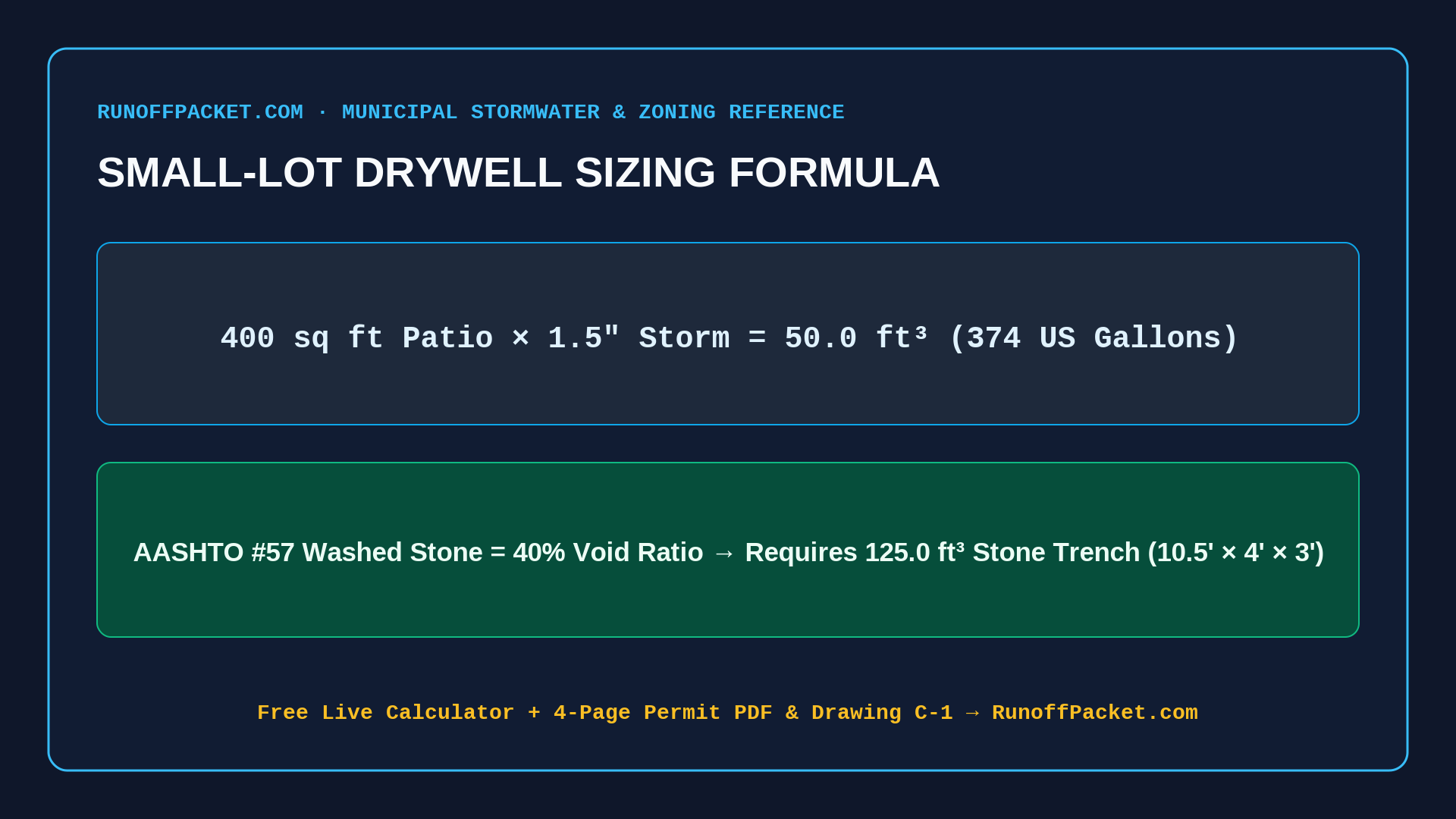
Mitigated Area (sq ft) × (Design Storm Inches ÷ 12) × Runoff Coefficient (1.00) - Worked Example (400 sq ft Patio @ 1.5″ Storm):
400 × (1.5 ÷ 12) = 50.0 ft³= 374 US Gallons of rainwater.
2. Why a Gravel Trench Must Be 2.5× Larger Than the Water Volume
Clean, double-washed angular crushed stone (AASHTO #57) is 60% solid rock and 40% empty void space (n = 0.40). Storing 50.0 ft³ of water in gravel therefore requires 50.0 ÷ 0.40 = 125.0 ft³ of washed stone — for example, a trench measuring 10.5 ft long × 4.0 ft wide × 3.0 ft deep beneath 12 inches of topsoil cover.
See instant PASS / FAIL coverage & detention gallons + download the 4-page Municipal Permit PDF with Vector Drawing C-1.